
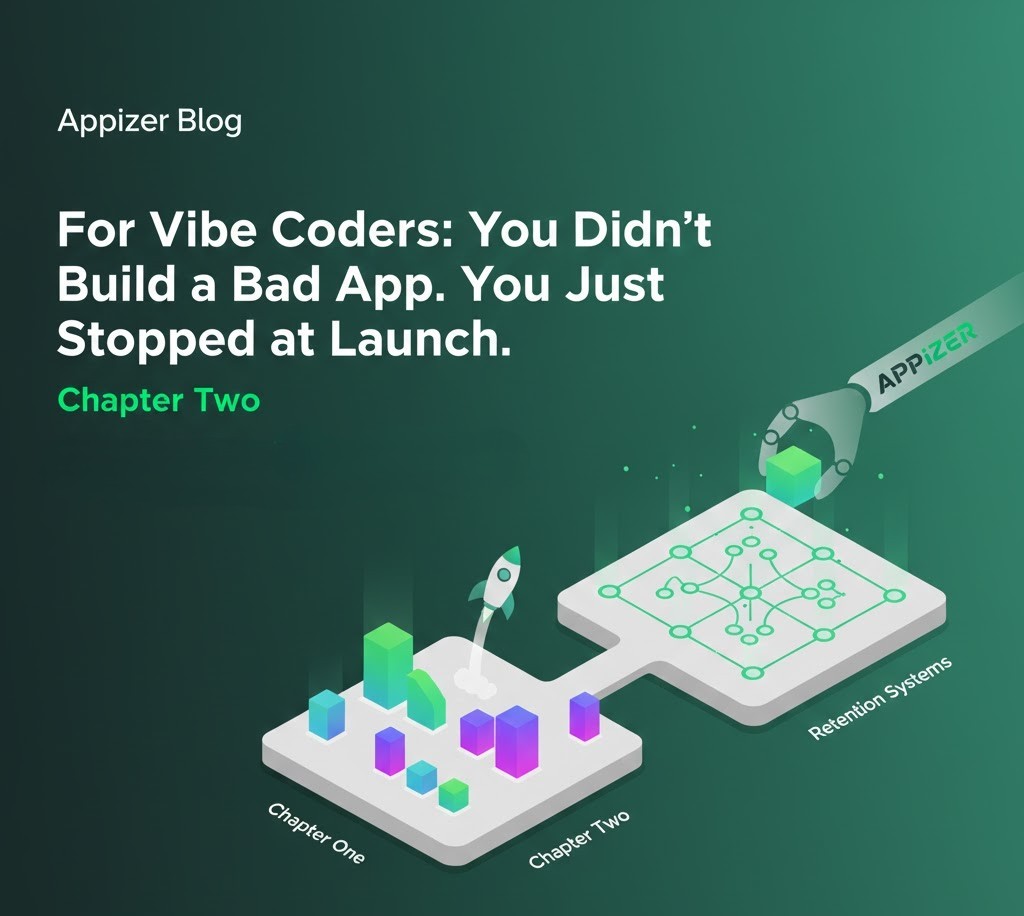
You didn’t fail at building your app. You stopped at launch.
And if you’re a vibe coder, that probably wasn’t intentional.
Let me guess how this went.
You had an idea.
You opened v0, Bolt, Windsurf, or Cursor.
You built fast, trusted your instincts, and shipped.
It felt good.
You checked analytics once or twice.
A few users showed up.
Nothing looked broken.
So you moved on.
A few days later, you opened the dashboard again.
You refreshed the page.
Then refreshed it one more time.
There was one active user.
And for a second, you wondered if it was just you.
No errors.
No angry emails.
No feedback.
Just silence.
If you’ve ever shipped an app before, you know exactly how that moment feels.
This Is How Most Apps Actually Die
Apps rarely fail loudly.
They don’t crash.
They don’t get flooded with bad reviews.
They don’t get roasted on social media.
Instead, people simply stop opening them.
That’s what makes it so hard to notice.
You’re busy building. You’re already thinking about the next feature or the next idea. So you tell yourself things like:
- Maybe users didn’t get it
- Maybe the timing was wrong
- Maybe I’ll come back to this later
Most of the time, you don’t.
And the app quietly fades away.
Vibe Coders Are Amazing at Chapter One
Here’s the important part: this is not a failure of skill.
Vibe coders are incredibly good at Chapter One.
Chapter One is:
- building fast
- shipping early
- launching without overthinking
- turning ideas into real products
Modern tools make this easier than ever. With v0, Bolt, Windsurf, Cursor, and similar platforms, you can go from idea to live app in days.
That part works.
The problem is what happens next.
Chapter Two Starts After the First Session
Chapter Two begins the moment a user closes your app for the first time.
This is where the real questions show up:
- Did they come back the next day?
- Did they understand what to do?
- Did they get stuck or confused?
- Did they forget the app even exists?
These answers decide whether your app grows or slowly goes quiet.
And most vibe coders never really see this phase clearly.
Not because they don’t care.
Because retention and engagement were never part of the plan.
Why Retention Gets Ignored (Especially by Solo Builders)
If you’re building alone or with a very small team, the tradeoff feels obvious.
Every hour you spend:
- setting up analytics
- learning engagement tools
- creating push notification campaigns
- figuring out user segmentation
Is an hour you’re not building the product.
So retention gets postponed.
And while it’s postponed, users quietly leave.
This isn’t a motivation problem.
It’s a time problem.
Silence Is More Dangerous Than Churn
Churn sounds dramatic.
Silence is worse.
A broken app gets fixed.
An app with angry users gets attention.
A quiet app gets abandoned.
When users disappear without a trace, it’s easy to assume:
- the idea wasn’t strong enough
- the market didn’t care
- it just wasn’t meant to work
So you move on.
You start the next project.
You repeat Chapter One.
You never really understand what went wrong.
The Real Problem Is a Missing Chapter Two System
At some point, it becomes clear this isn’t about effort or discipline.
It’s about the lack of a system.
You need something that:
- notices when users stop showing up
- understands what they did before leaving
- tells you when attention is slipping
- exists even while you’re building something else
Without that, most apps rely on hope.
And hope is not a retention strategy.
Every App Has a Chapter Two (Whether You Build It or Not)
Chapter Two exists whether you plan for it or not.
It’s the chapter where:
- habits either form or disappear
- users decide if your app matters
- silence either gets addressed or ignored
Most vibe coders never intentionally enter this chapter.
Not because they failed.
But because no one told them how quiet failure actually sounds.
If This Feels Familiar, You’re Not Alone
If you’ve ever shipped an app you cared about
and watched it slowly go quiet
without knowing exactly when or why
you’re not alone.
You didn’t fail at building.
You just stopped at launch.
You never built Chapter Two.
And that’s what this blog is about.