
Most developers do not ignore retention because they do not care.
They ignore it because modern app-building workflows make it difficult to see, harder to act on, and nearly impossible to maintain without dedicated time.
This problem is especially visible among vibe coders: solo developers and small teams who build and ship products rapidly using modern tools.
If you have ever launched an app, seen early activity, and then watched engagement slowly decline without a clear reason, you are experiencing a structural gap, not a personal failure.
Retention Fails Quietly by Design
Unlike bugs or crashes, user churn does not create alerts.
There is no error message when a user stops returning.
No notification when engagement drops from daily to weekly.
No warning when momentum fades.
Most analytics tools are retrospective. They show what has already happened, not what is about to happen.
By the time retention looks like a problem in a dashboard, a meaningful portion of users has already disengaged.
This makes retention uniquely difficult to manage, especially without systems in place from day one.
Why Vibe Coders Are Disproportionately Affected
Vibe coders optimize for speed.
They:
- ship MVPs quickly
- iterate in short cycles
- work across multiple ideas
- prioritize building over operational overhead
This approach works exceptionally well for launching products. It does not work as well for long-term engagement.
Retention requires sustained attention:
- monitoring behavior over time
- recognizing absence rather than activity
- responding before disengagement becomes permanent
These tasks compete directly with product development. In a solo or small-team environment, product development usually wins.
As a result, retention is postponed, not rejected. But postponed retention often becomes invisible retention.
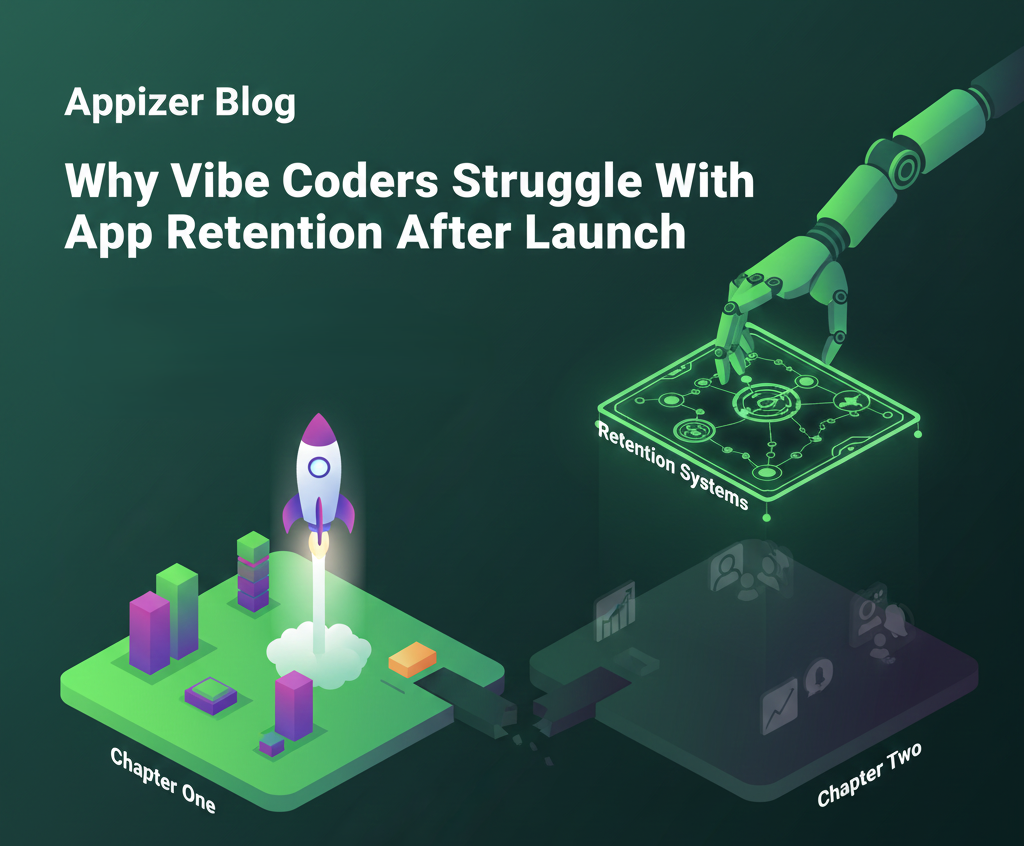
Chapter One Tools Do Not Support Chapter Two Problems
Modern development tools have dramatically reduced the cost of building and shipping applications.
Platforms like v0, Bolt, Windsurf, and Cursor excel at:
- accelerating development
- reducing setup time
- removing technical friction
However, these tools stop at launch.
They do not:
- surface disengagement as a first-class signal
- help identify which users are at risk of leaving
- provide guidance on when or how to re-engage users
This creates a gap between shipping an app and sustaining its usage. That gap is where many products stall.
Analytics Alone Does Not Solve Retention
Most apps do have analytics.
Developers can see:
- daily active users
- session counts
- retention curves
But analytics answers “what happened,” not “what should happen next.”
Turning insight into action requires additional work:
- defining meaningful segments
- choosing appropriate timing
- crafting relevant messages
- repeating this process continuously
Without a system to automate these steps, analytics often becomes passive information rather than an active tool.
For busy builders, this results in awareness without execution.
Retention Is a Time Constraint, Not a Knowledge Gap
Advice about retention often assumes a lack of understanding.
In practice, the issue is usually time.
Every hour spent configuring engagement tools or managing campaigns is an hour not spent improving the product itself. For vibe coders, this tradeoff is significant.
As a result, retention efforts are delayed until “later.”
Later rarely arrives.
This is not a discipline problem. It is a prioritization problem created by limited bandwidth.
The Missing Layer Between Insight and Action
What most apps lack is not data, intent, or effort.
They lack a system that:
- detects disengagement early
- understands recent user behavior
- responds consistently without manual intervention
Without such a system, retention depends on human attention. And attention does not scale in small teams.
This is why many well-built apps slowly lose users without a clear point of failure.
Understanding Chapter Two
Building and shipping an app is Chapter One.
Keeping users engaged after their first session is Chapter Two.
Most builders complete Chapter One successfully. Very few have the tools or time to execute Chapter Two effectively.
When an app goes quiet after launch, it is rarely because the product was fundamentally flawed. More often, it is because Chapter Two was never supported.
Understanding this distinction is the first step toward fixing the problem.